How to Manage Anxiety: Simple Steps That Actually Help
Learn practical tools to regulate anxiety during peak stress, including body techniques, thought work, and behavior steps.
About this article
Editorial review and limitations
This article is educational and does not replace care from a psychologist, psychotherapist, physician, or emergency service.
If distress is escalating, affecting sleep or work, or you have thoughts of self-harm, please seek in-person or emergency support. editorial principles.
Why we feel anxious and when it becomes a problem
Anxiety is the nervous system’s alarm signal. It helps us notice possible danger, prepare, and react. In moderate amounts, anxiety is useful: it makes us check details, prepare for conversations, and avoid real risks.
The problem begins when the alarm becomes too sensitive. The body reacts as if there is danger even when the threat is uncertain, distant, or imagined. Then anxiety stops helping and starts draining energy.
Anxiety is not weakness or “thinking too much for no reason.” It is a combination of body arousal, thoughts, habits, and previous experience. The goal is not to remove anxiety completely, but to reduce its intensity and stop letting it run your life. A useful sign is flexibility: you can feel anxious and still answer a message, attend a meeting, rest, or ask for help. When anxiety removes choice, the work is to return choice gradually.
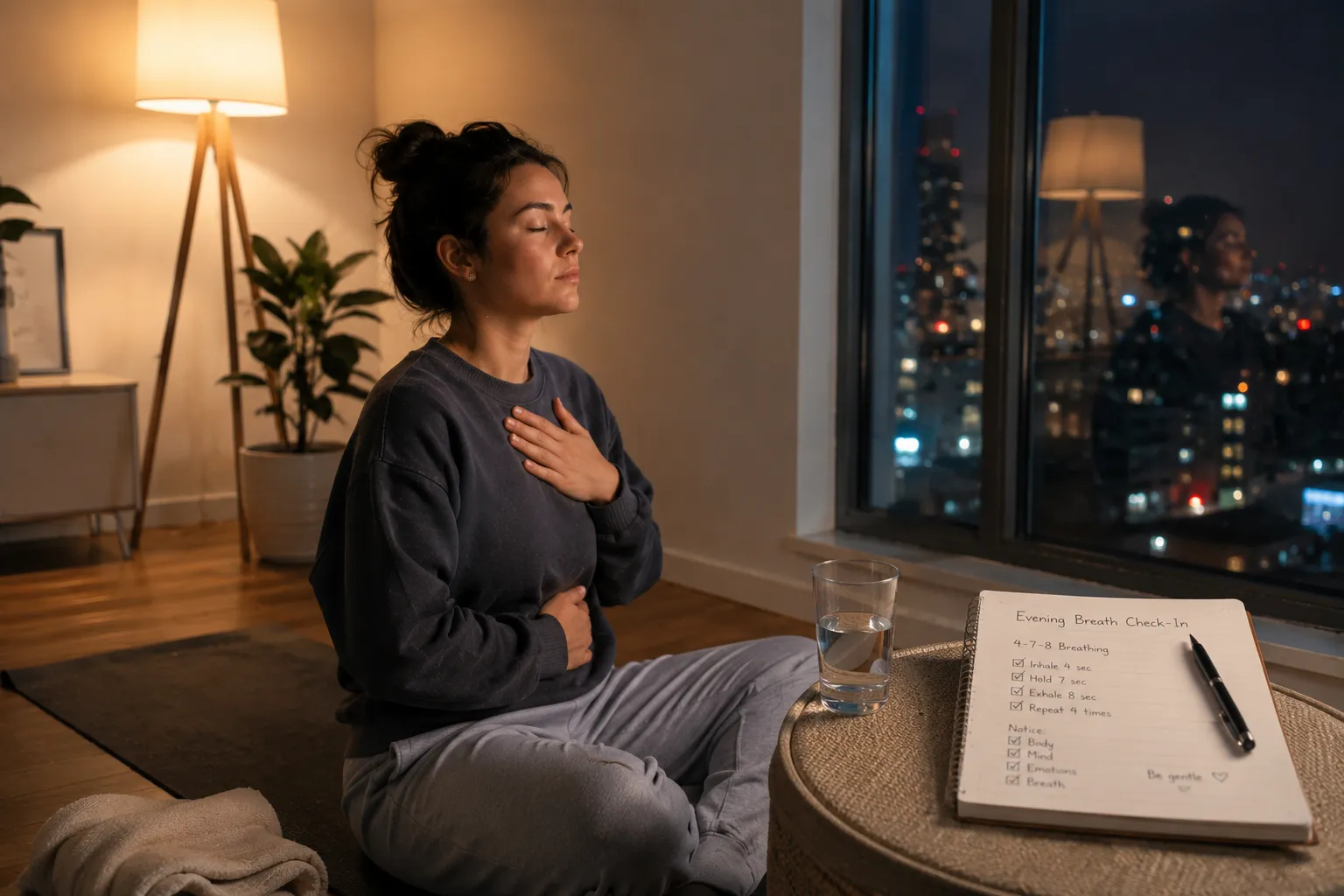
Technique 1: Box Breathing
Box breathing is a simple way to tell the body that the situation is not an emergency.
Use this rhythm:
- Inhale for 4 counts.
- Hold for 4 counts.
- Exhale for 4 counts.
- Hold for 4 counts.
Repeat for 2-4 minutes. If holding your breath feels uncomfortable, skip the holds and simply make the exhale longer than the inhale.
This technique works best when practiced before anxiety peaks. It is not magic, but it can lower physiological arousal enough for clearer thinking. If you practice once or twice a day while calm, the body recognizes the pattern faster during stress.
Technique 2: 5-4-3-2-1 Grounding
Grounding brings attention back from frightening predictions to the present moment.
Name:
- 5 things you can see
- 4 things you can feel
- 3 things you can hear
- 2 things you can smell
- 1 thing you can taste
Do not rush. The point is to make the brain register: “I am here, now, in this room.” This is especially helpful during panic, derealization, or racing thoughts.
Technique 3: Cognitive reframing
Anxiety often speaks in predictions: “I will fail,” “they hate me,” “something is wrong with me.” Cognitive reframing helps separate facts from interpretations.
Write three columns:
- Situation: what actually happened?
- Automatic thought: what did my mind predict?
- Alternative view: what else could be true?
The goal is not forced positivity. The goal is accuracy. A more balanced thought might be: “I do not know how they reacted yet. I can ask or wait instead of assuming the worst.”
Technique 4: Information hygiene
An anxious brain wants more information, but endless checking often increases anxiety. News, social media, symptom searches, and message rereading can keep the nervous system activated.
Try:
- Set two fixed times for news or messages.
- Do not search symptoms at night.
- Remove triggering apps from the first screen.
- Replace checking with one grounding action.
Information hygiene is not avoidance. It is choosing when and how much information your nervous system can process.
Technique 5: Physical activity as an antidepressant
Movement helps the body use stress hormones and return to baseline. You do not need intense workouts. A brisk walk, stretching, dancing, cycling, or light strength training can help.
The key is regularity. Ten minutes every day may be more useful than one exhausting workout followed by a week of nothing.
Movement also restores a sense of agency: “I can influence my state.” For anxiety, that feeling matters.
Technique 6: Anxiety journal
An anxiety journal helps detect patterns. Use a simple template:
- Trigger: what started it?
- Body: what did I feel physically?
- Thought: what did my mind predict?
- Behavior: what did I do?
- Result: did it help long term or only briefly?
- Next experiment: what will I try next time?
After one or two weeks, patterns become visible. You may notice that anxiety rises after poor sleep, conflict, caffeine, overwork, or uncertainty. The journal is not for judging yourself; it is for seeing where the nervous system needs support and where avoidance keeps the loop alive.
Technique 7: Know when to ask for help
Self-help is useful, but it has limits. Seek professional support if anxiety causes panic attacks, disrupts sleep, makes you avoid important tasks or relationships, or produces constant physical symptoms.
Therapy can help work with thoughts, avoidance, body alarm, and deeper patterns. AI support can be a first step for reflection and practice, but severe anxiety deserves human professional care.
Sources:
- Anxiety Disorders - National Institute of Mental Health, accessed: June 7, 2026
- Anxiety self-help guide - NHS inform, accessed: June 7, 2026
- 988 Suicide & Crisis Lifeline - 988 Lifeline, accessed: June 7, 2026
Read next
Related articles that may help you go deeper
Start moving toward calm today
Therly is ready to listen and help you reflect at any time. Private, immediate, and supportive.
Try for free